

Ever wonder how food came to be? Early humans discovered fire and learned to cook. They took raw ingredients and transformed them into meals with new textures and flavors.
Food wasn’t invented in one moment. It grew through endless trial and error over many years. People tried methods like boiling in clay pots and fermenting ingredients, each step adding something special.
These simple experiments turned into the culinary art we enjoy today. Understanding this evolution shows us key moments in our shared edible history.
Exploring Who Invented Food: Tracing Edible Origins
Early humans never waited for a single genius to come up with food. Instead, they slowly learned how to cook and prepare meals over hundreds of thousands of years. Around 1 million years ago, our ancestors started cooking raw meat and plants with fire. This simple act changed textures and flavors, setting the stage for our modern meals.
Different cultures played a part in shaping how we eat today. In Israel, cooked starch grains have been found that date back 120,000 years. By 10,000 BC, grain was grown on a large scale, which boosted meal production. Around 7000 BC, using clay pots for boiling gave cooks more control over their recipes. In Mesopotamia, approximately 6000 BC, fermentation was used to both preserve food and enhance its taste. China shows a similar story with early cooking pots that are about 20,000 years old. Later, in the 1st century BC, Roman thermopolia provided quick meals for busy city dwellers, and Medieval Arab kitchens pushed boundaries with spices and creative cooking methods. Each of these steps helped build the way we eat now.
- Boiling in clay vessels (around 7000 BC)
- Fermentation in Mesopotamia (around 6000 BC)
- China’s first cooking pots (about 20,000 years ago)
- Roman thermopolia (1st century BC)
- Medieval Arab kitchens’ spice innovations
Key Milestones in History of Food Inventions
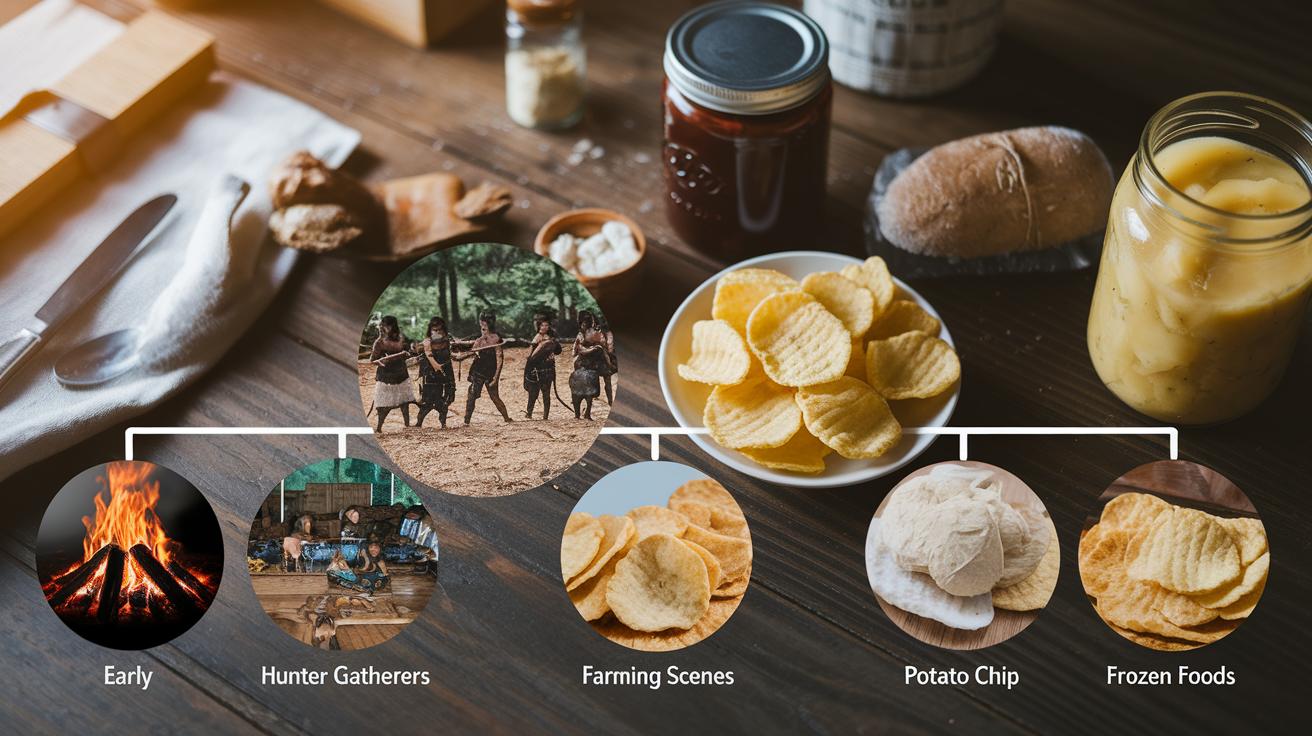
Humans have changed how we cook and eat over thousands of years. Early on, our ancestors learned to control fire nearly 400,000 years ago. This breakthrough let them cook meat and tubers so meals became safer and more tasty. Around 10,000 BC, the rise of farming introduced grains and beans into our diets and helped people settle in one place. In 1809, Nicolas Appert created canning. His method helped keep food fresh longer and set the stage for modern food preservation. In 1853, George Crum invented the potato chip. Its simple crunch turned snack time into a favorite treat. By the 1920s, Clarence Birdseye’s flash-freeze method made it possible to enjoy seasonal foods all year. These key inventions not only improved food quality and shelf life, they changed the way we eat by building on practical ideas over time.
| Milestone | Date | Innovator/Notes |
|---|---|---|
| Control of fire | ~400,000 years ago | Allowed cooking of meat and tubers |
| Neolithic agriculture | ~10,000 BC | Introduced grains and beans |
| Appert’s canning method | 1809 | Paved way for modern food preservation |
| Potato chip invention | 1853 | Introduced a beloved crunchy snack |
| Flash-freeze technology | 1920s | Enabled year-round access to seasonal foods |
Industrial Advances in Food: From Canning to Mass Production
Industrial advances have changed the way we process and produce food. Old methods of preserving meals evolved into modern techniques that help food travel long distances and stay fresh longer. Pioneers introduced new processes that not only expanded our dinner table options but also reshaped global food supply chains.
In 1809, Nicolas Appert introduced the sealed-jar method, sparking a revolution in food preservation. This innovation made it possible to store food safely for extended periods and set the stage for Peter Durand’s tin-can patent in 1810, which further improved storage techniques. Later, in 1937, Hormel’s Spam brought processed meats into the mainstream by offering a reliable and affordable protein option. These early breakthroughs paved the way for large-scale processing, ensuring consistent quality and longer shelf life for millions of consumers.
Fast food took a giant leap forward with the opening of White Castle’s first slider restaurant in 1921. The rise of assembly lines and factory farms in the late 1800s boosted production speed and volume, lowering meal costs and making them more accessible. By streamlining food preparation, the industry made it possible for diners to enjoy the same familiar tastes at every location. This shift not only sped up service but also changed how we eat every day.
Modern Culinary Innovation and the Future of Food

Science and creativity are teaming up to change the way we eat. NASA's freeze-drying technology from the 1960s made space meals possible and paved the way for today's food preservation methods. In the 1980s, chefs like Heston Blumenthal introduced molecular gastronomy, mixing art and science in the kitchen. Birdseye's flash-freeze method still plays a key role in keeping frozen meals tasty and fresh. Since 2016, companies like Impossible Foods and Beyond Meat have pushed plant-based options to the front, offering foods that mimic traditional flavors with innovative ingredients. New ideas like 3D-printed and lab-grown foods hint at a future where meals are made to order and sustainability is a top goal.
- NASA's 1960s freeze-drying tech made space meals possible.
- In the 1980s, Heston Blumenthal and others began exploring molecular gastronomy.
- Birdseye's flash-freeze method keeps frozen meals delicious.
- Impossible Foods and Beyond Meat lead the push for plant-based alternatives.
- 3D-printed and lab-grown foods point to a future of custom, sustainable meals.
Final Words
In the action, we traced early cooking breakthroughs that sparked the edible evolution. Our blog post covered prehistoric practices, key industry milestones, and modern advances from canning to plant-based alternatives.
We explored how simple methods led to lasting innovations in everyday dining. The timeline shows that asking who invented food highlights a gradual buildup that continues to shape menu trends and business strategies. The past fuels today’s creativity, promising a bright and tasty future.
FAQ
Who invented food in America?
The idea of “inventing” food in America ties to centuries of diverse culinary traditions evolving from Native American ingredients and immigrant influences, rather than a single inventor.
What was the first food invented or created?
The concept of a “first food” stems from our ancestors gathering natural edibles, with early humans cooking raw grains, fruits, and tubers rather than someone inventing food from scratch.
What was the first food ever eaten by humans?
The first food eaten by humans likely consisted of raw fruits, nuts, and vegetables, with early cooking methods later transforming these natural ingredients after the discovery of fire.
What was the first food ever eaten in space?
The first food eaten in space was a form of freeze-dried meal, typically including items like rehydrated applesauce and cubes of food, developed for early space missions.
Who invented the word food?
The word “food” comes from Old English roots that evolved over time to describe substances consumed to provide energy and nourishment.
Who invented people?
The idea of inventing people does not apply, as human development is a result of millions of years of evolution rather than a deliberate creation by an individual.
Who invented fast food?
Fast food emerged gradually as quick-serve restaurants like White Castle popularized efficient meal production; it was not the brainchild of one individual but evolved through market demand.
Who are famous food inventors and who invented making food?
Notable food inventors include innovators like Nicolas Appert, who pioneered canning, and George Crum, credited with creating potato chips, marking key steps in making food widely accessible.
What food was invented by black inventors?
Black innovators have shaped many culinary traditions, contributing to soul food classics and barbecue techniques that have enriched America’s diverse food scene.
What food was accidentally invented?
Potato chips were reportedly an accidental invention when a chef, attempting to please a customer, sliced potatoes too thinly, leading to a now classic snack.